Stephen Guerin, Eric Rodenbeck, Rosalea Monacella, Craig DouglasThe Stigmergic Web as Matrix: Reaction–Diffusion for Decentralized Agentic Coordination
Cognitive Landscapes Group
Harvard Graduate School of Design
Keywords: stigmergic web, reaction-diffusion, artificial-life, artificial-intelligence, landscape-architecture, decentralized architecture, landscape-ecology
This paper explores how complex, emergent patterns develop from simple, local reaction-diffusion processes, building on the foundational work of Alan Turing.
“Does it explain the zebra? It may explain the stripes; the horse is harder.”
“Such a system, although it may originally be quite homogeneous, may later develop a pattern or structure due to an instability of the homogeneous equilibrium, which is triggered off by random disturbances.” — Alan M. Turing, The Chemical Basis of Morphogenesis [118]
This paper argues that AI should be approached as a landscape design problem and that the web can be reinterpreted as a matrix for decentralized cognition rather than as a neutral transport layer or merely a feeder system for centralized cloud intelligence.[30][85] In the landscape-ecology sense, the matrix is the dominant and most connected background that shapes movement and process; applied to digital systems, this suggests that URI space, linked resources, caches, and local services can function as the primary medium through which agentic coordination emerges.[30][40][159]
Building on Turing’s reaction–diffusion account of pattern formation and contemporary work on stigmergic coordination, the paper proposes a model of the stigmergic web in which GET–transform–PUT cycles are reactions, propagation across linked URIs and peer pathways is diffusion, and cache invalidation or time-to-live is evaporation.[118][14][81] In this view, phone browsers, laptop browsers, local Node.js services, WebDAV resources, WebRTC data channels, and tunnelled edge services can participate in a shared computational landscape where agents coordinate indirectly by writing traces into a common medium rather than by relying on centralized orchestration.[81][52][160]
The paper’s central claim is that decentralized web architectures can support forms of collective intelligence that are more local, legible, and publicly generative than current cloud-centric AI stacks.[76][158][161] Instead of assuming that coordination must be concentrated in proprietary platforms, the stigmergic web treats the web itself as a living matrix in which repeated use creates desire lines, local governance shapes corridors, and intelligence is routed through shared landscapes rather than extracted into remote enclosures.[30][37][52]
Does a theory of computation explain the zebra, or only its stripes? Turing’s morphogenesis work showed how simple reaction–diffusion systems can break a homogeneous field into patterned bands and spots, but the living animal—its development, metabolism, behavior, and history—remains more than a surface pattern.[118][139] This paper takes that distinction seriously for AI: pattern formation is easier than life, and coordination patterns over a network are easier than the full, situated intelligence of communities living with that network.[121][127]
The Cognitive Landscapes group starts from the premise that landscape is cognition: under the right conditions, landscapes of interaction can compute.[121][124] Work on criticality in living systems suggests that media poised near transitions can support rich repertoires of response and information processing, while landscape ecology has long emphasized how matrices, patches, and corridors shape what can move, survive, and cohere.[30][79][85][121] Instead of treating computation as something that happens inside sealed boxes and then projects onto space, this view treats space itself—traces, gradients, thresholds, and flows—as a cognitive medium.[121][127]
In parallel, the web has been largely treated as infrastructure for centralized cloud intelligence: browsers as thin clients, platforms as dominant patches, and data flows as one-way funnels into remote enclaves.[77][80][158] Coordination is assumed to happen in proprietary control planes and orchestration layers, not in the fabric of URIs, caches, and local services. Yet work on stigmergic coordination and linked data already demonstrates that shared information substrates can support decentralized organization when agents interact by leaving and following traces rather than exchanging explicit messages alone.[14][81][160]
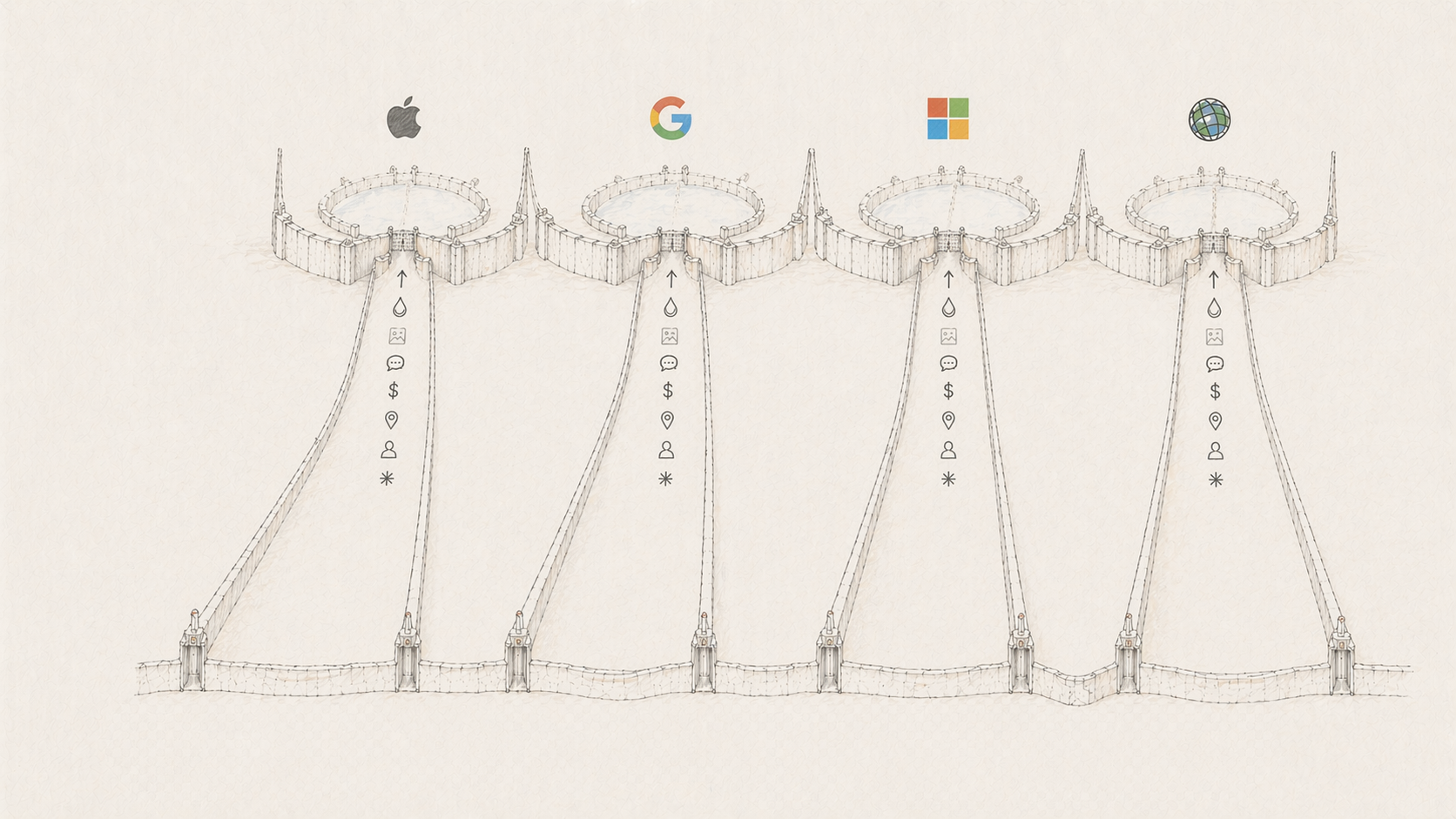
Figure 1: The prevailing mental model of AI as a centralized cloud: a single dominant cloud patch in the center, with many thin clients at the edge sending data in and receiving results back on one-way corridors.
This diagram is accurate as a description of most current AI systems. From a landscape-architecture perspective, it represents a hardened matrix with an over-concentrated central patch and narrow, one-way corridors.
Figure 1 shows the status-quo cloud AI landscape: one overgrown central patch, edge devices treated as terminals, and one-way flows into centralized intelligence collectors. Later in the paper, Figure 3 sketches a different digital landscape: many small patches (phones, laptops, local nodes) connected by writable corridors (HTTP/WebDAV, WebRTC, Acequia tunnels), where intelligence can flow laterally and return locally. The current paper focuses on diagnosing why the Figure 1 landscape is a kind of digital brownfield of intelligence collectors, enclosure, and extraction, and it opens the question of how to move toward something more like Figure 3. The concrete intervention (gsd.live, ants, Hubler, Acequia governance, sym-alignment) will be developed in a second paper.
This paper brings these threads together by proposing the stigmergic web as a matrix for decentralized agentic coordination. In this framing, URIs, linked documents, caches, and edge services form a reaction–diffusion medium: GET–transform–PUT cycles are reactions; propagation across links and peer-to-peer channels is diffusion; cache invalidation and time-to-live define evaporation.[14][81][166] Phone browsers, laptop browsers, and small local Node.js services, connected via HTTP, WebRTC, WebDAV, and Acequia tunnels, become patches in this matrix whose repeated use carves desire lines of intelligence across the landscape.[52][81][160]
The goal is architectural rather than purely metaphorical. By treating the web itself as a cognitive landscape—capable of carrying gradients, supporting local governance, and hosting reactive resources—the stigmergic web offers an alternative to cloud-centric AI stacks that concentrate coordination in a few sites.[76][158][161] The following sections develop this argument in three steps: first, by situating the approach in landscape ecology and computation in physical systems; second, by introducing a reaction–diffusion model of stigmergic coordination on the web; and third, by outlining a concrete architecture that uses browsers, tunnels, and local services to realize this matrix in practice.
The theoretical move in this paper is rooted in a material, studio-based practice. Eric Rodenbeck’s recent experiments with fermented inks and reaction–diffusion painting treat paper and canvas as morphogenetic fields: pigments, binders, moisture, and gravity play the role of interacting species whose local reactions and diffusions generate emergent forms.[215][217] These experiments did not merely illustrate the argument; they helped generate it. The hands-on work with fermented inks helped the group think materially about Turing patterns, making the abstract idea of landscape as a computational medium feel tangible. From studying these wet reactions, the group began mapping reaction–diffusion logic directly onto the stigmergic web architecture.
In these works, ink is not simply applied but cultivated; it is fermented, thickened, thinned, and allowed to run, crack, pool, and branch under changing conditions, producing structures that are recognizably Turing-like but also irreducibly contingent.[215][218] The resulting artifacts are landscapes of trace—in some places cellular, in others dendritic or banded—that make visible how simple rules in a responsive medium can produce complex, situated pattern.[215][217]
In practice, the ink is not a neutral medium but a carefully tuned chemistry. One set of studies uses an iron liquor made from approximately 262 g iron, 50 g salt, and 505 g Chardonnay vinegar, producing an acidic, metal-rich solution that darkens and precipitates as it reacts with tannins and paper fibers over time.[223][226][230] A second ferment combines roughly 50 g olive leaves, 45 g sugar, and 700 g water, yielding a tannin- and sugar-bearing solution whose microbial activity and evolving viscosity further shape how pigments diffuse, pool, and crack as they dry.[223][225][230] When these liquids meet on paper or canvas, they form genuine reaction–diffusion systems: metal ions, organic acids, plant tannins, and microbial byproducts compete and cooperate, creating branching, cellular, and banded forms that visibly record the kinetics of the medium rather than the will of a single author.
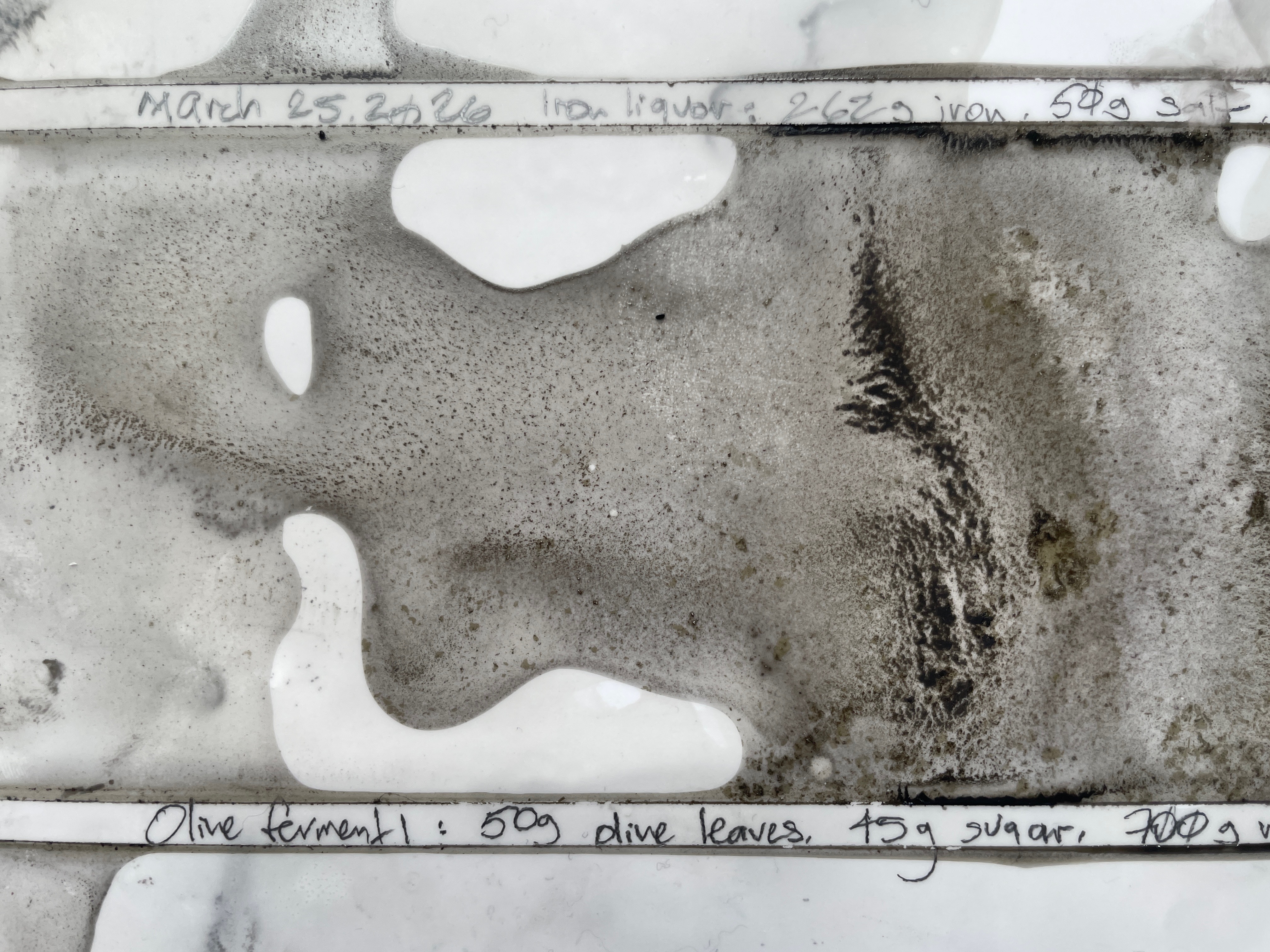

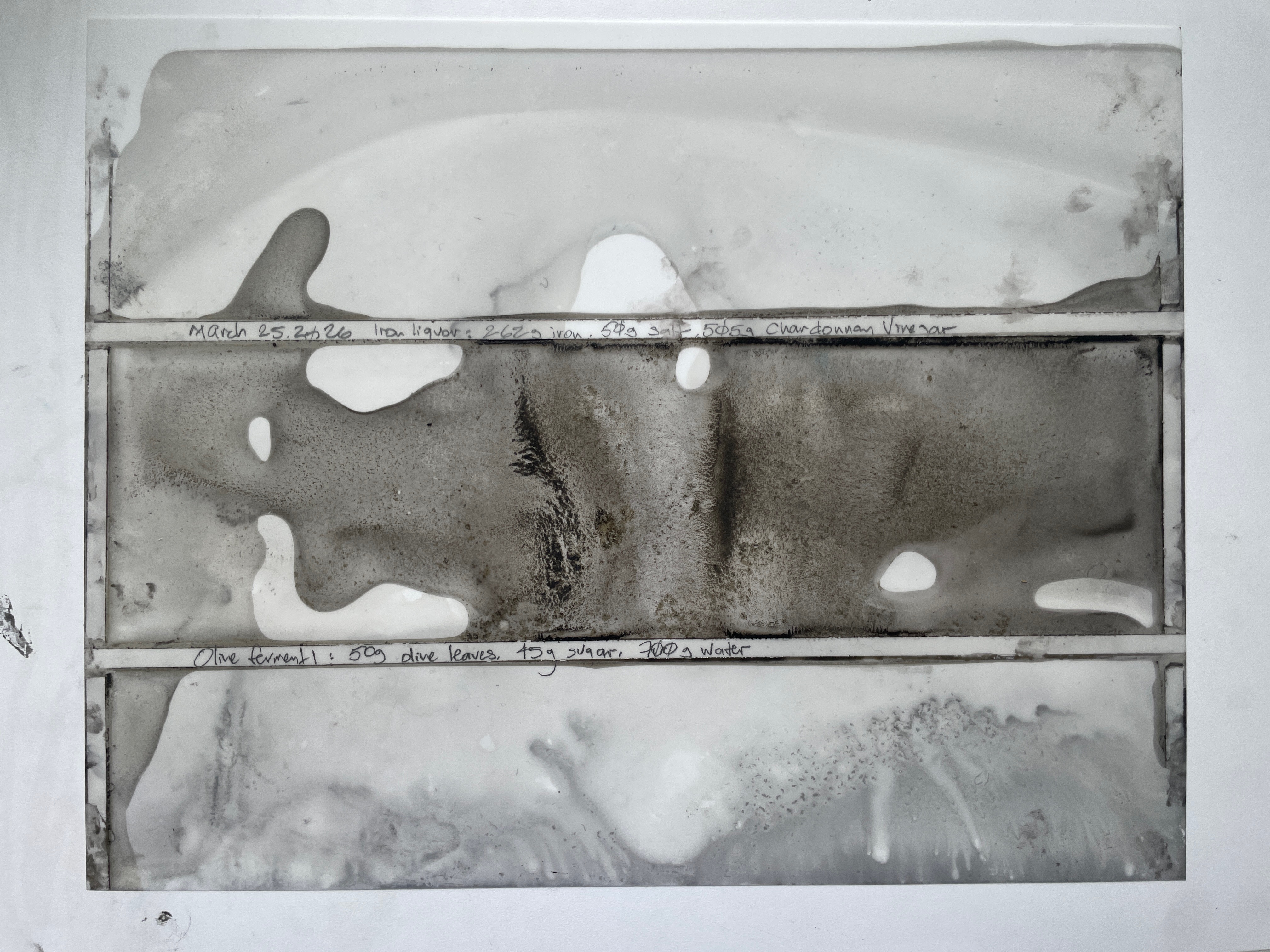
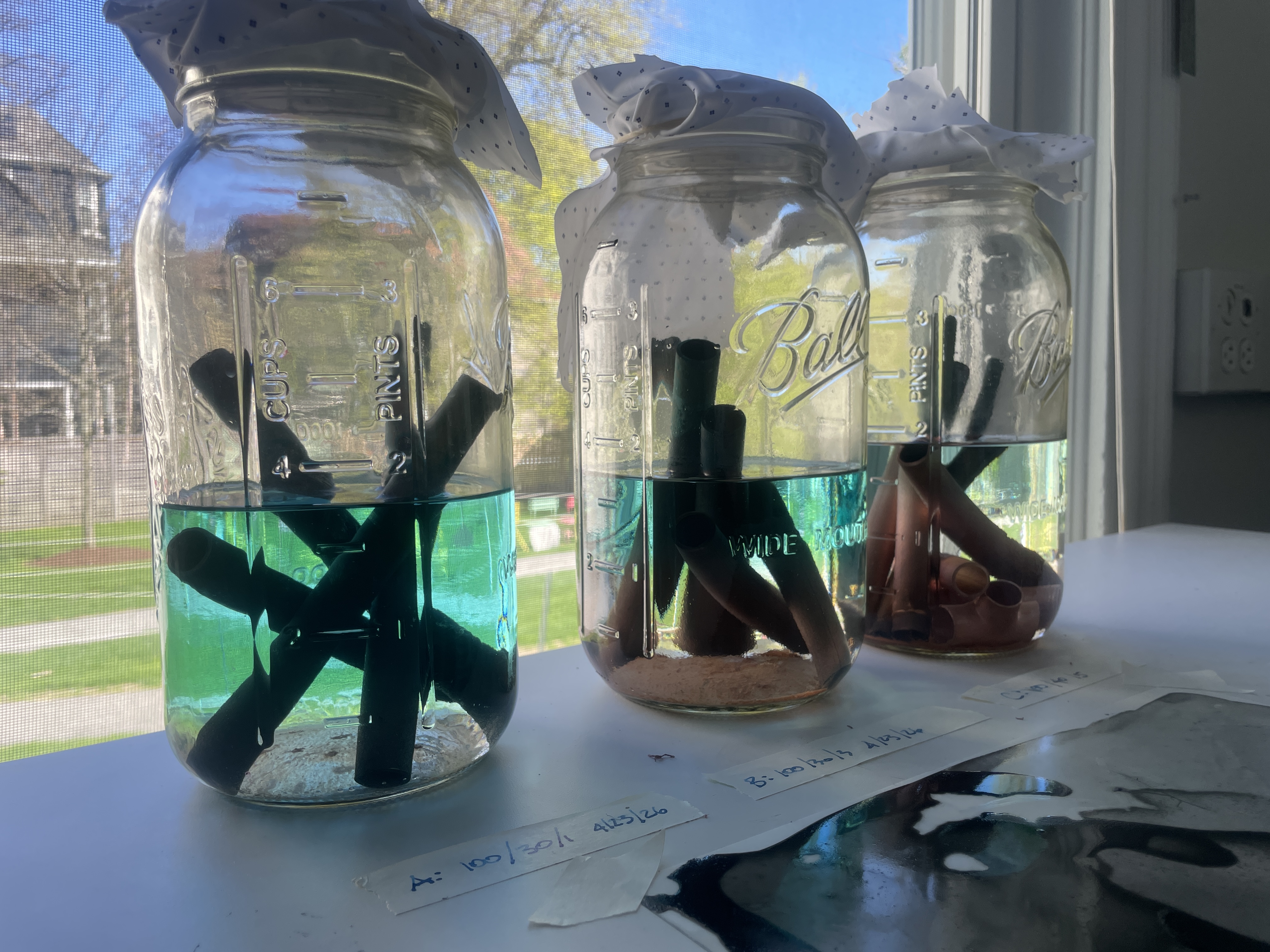
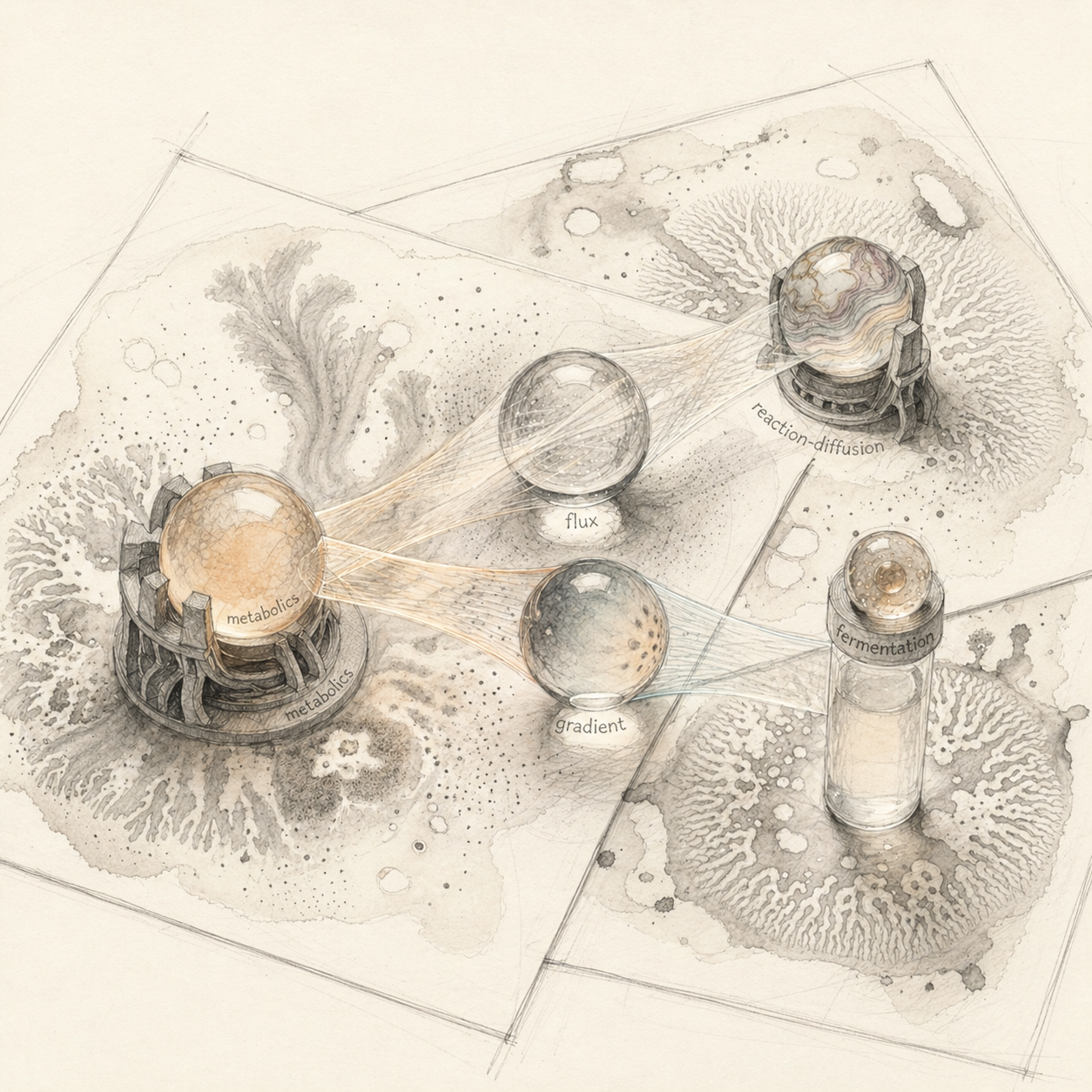
Figure 2: Fermented ink reaction–diffusion studies on paper, showing branching, cracking, and cellular morphologies.
Working with such materials highlights a distinction that is easy to miss in purely digital simulations. Many computational demonstrations of Turing patterns treat the medium as ideal and uniform; pixels update synchronously according to precise equations, and the results can be tiled, remapped, or recolored at will.[215][217] Fermented inks instead foreground thickness, uneven drying, impurities, and the inertia of wet surfaces. Some regions resist flow; others draw it in; previous layers alter the behavior of later ones. The patterns are still computational in the broad sense—they arise from repeated local rules—but the computation is inseparable from the physical properties and history of the medium.[215][218] This is closer to the kind of landscape computing that interests the Cognitive Landscapes group.[121][127]
To move from an ecological painting studio to a digital infrastructure requires a direct mapping of these physical properties onto web protocols. In this translation, the wet medium of paper and canvas becomes the web matrix itself. The physical pigment or chemical trace becomes a URI, a cache entry, or a shared-state trace. The physical diffusion of liquids across a surface maps to the propagation of state across linked resources and peer-to-peer pathways. Finally, the drying of the ink, the formation of cracks, and the decay of organic material map to digital evaporation: cache invalidation, time-to-live (TTL) expiry, and the deliberate cooling of network trails.
The same sensibility informs the software side of the project. Turing’s original morphogenesis paper is already a form of artificial life: it shows how a simple reaction–diffusion system can give rise to biological-like structure without presupposing a central designer.[118][215] Contemporary work extends this into software alife, where simulated reaction–diffusion fields generate patterns, textures, and morphologies that can be inspected, manipulated, and embedded in larger systems.[215][218] In the architecture proposed here, browsers and local services play the role of “cells” in a digital tissue: each runs local update rules (GET–transform–PUT), each interacts with its neighbors through limited-range exchanges, and the aggregate effect is a dynamic pattern of traces across the web landscape.[81][166][52]
This parallel between wet and digital experiments is not merely aesthetic. It reinforces the paper’s core ontological claim: that cognition can be lodged in landscapes and media, not only in discrete agents or central servers.[121][124][127] Fermented ink pieces show how a tuned medium can compute in the Turing sense by amplifying and stabilizing certain perturbations while dampening others.[215][218] The stigmergic web aims to do something analogous with URIs, caches, and local services: construct a digital medium in which some traces are amplified into corridors of intelligence, others evaporate, and the resulting patterns are legible and revisable as part of a shared landscape rather than hidden inside proprietary systems.[81][166][52]
Landscape ecology offers a language for thinking about extended systems that is already architectural rather than purely statistical. In the patch–corridor–matrix model, patches are relatively homogeneous areas that differ from their surroundings, corridors are linear elements that facilitate movement between patches, and the matrix is the dominant background that controls most flows and processes at the landscape scale.[30][40][85] Subsequent work has emphasized that the matrix is not empty space but an active medium: its permeability, heterogeneity, and management practices strongly condition which organisms, materials, or signals can move, persist, or cohere.[79][82][159]
If cognition is distributed—across bodies, tools, environments, and histories—then landscapes can be understood as cognitive media: they encode constraints, affordances, and memory in their very structure.[121][124][127] A trail network records repeated use, making future movement easier along some paths and harder along others; a river system channels flows and sediments, shaping what can grow where; an urban street grid filters encounters and information, amplifying some interactions while suppressing others.[30][79][165] In each case, patterns of activity both arise from and reshape the landscape, producing a form of situated computation in which the medium participates in decision-making by guiding, permitting, or blocking possible moves.[121][127]
The web can be read through the same lens. URIs, hyperlinks, and content types define patches; navigation structures, APIs, and tunnelled connections function as corridors; and the overall substrate of HTTP, DNS, caching layers, and local servers acts as a matrix in which digital movement occurs.[81][83][160] In practice, however, much of today’s web behaves as a matrix optimized for centralized collection and control: user activity and artifacts are channeled along narrow, platform-defined corridors into large patches—cloud platforms, social networks, data lakes—while the wider matrix is relatively under-activated as a medium for coordination.[77][80][158]
A stigmergic web reverses that emphasis by treating the matrix itself as the primary site of coordination. Stigmergy, as developed in biology and extended in distributed systems, refers to indirect coordination through traces in a shared environment: agents leave marks (physical or informational) that influence the subsequent actions of others, enabling collective behavior without centralized control.[14][81][160] On the web, those traces can be edits to shared documents, updates to linked data, cached fragments, or typed resources exposed via simple protocols. When agents operate by reading and writing such traces, the matrix becomes a computational landscape: repeated use deepens certain corridors, governance rules can open or close paths, and the emergent mosaic of patches and connections encodes a living map of collective intelligence.[14][81][166]
In this sense, the question is not only what AI models we run on top of the web, but what kind of web we are asking them to inhabit. A matrix designed as a passive delivery channel for centralized services will produce very different cognitive possibilities than a matrix designed as a stigmergic medium in which small agents and communities can carve, maintain, and govern their own corridors of intelligence.[30][79][158] The next section introduces a reaction–diffusion formulation of these dynamics, making explicit how GET–transform–PUT cycles, propagation, and decay can be treated as field equations over the stigmergic web.
The central technical claim of this paper is that stigmergic coordination on the web can be modeled as a reaction–diffusion process over a shared informational medium.[14][166] In classical stigmergy, agents do not coordinate by direct negotiation or centralized command; they coordinate indirectly by reading and modifying traces in a common environment, with those traces carrying scalar strength, limited locality, and finite lifetime.[178][14] This is precisely the structure needed for a reaction–diffusion interpretation: local actions transform the state of the medium, while the effects of those actions spread, persist, and decay across space and time.[14][174]
On the web, the medium is not a chemical substrate but a distributed field of URIs, representations, caches, event signals, and typed resources.[81][166] A reaction occurs when an agent reads one or more resources, performs a transformation, and writes a result back into the environment through a PUT, PATCH, POST, or other state-changing operation. In the architecture proposed here, the basic reaction primitive is a GET–transform–PUT cycle: agents gather local state, compute a modification, and inscribe that modification into the shared web substrate so that later agents can encounter it.[52][166] The significance of this cycle is not only that it updates content, but that it externalizes intermediate intelligence into the environment itself, allowing coordination to proceed through the medium rather than through a central planner.[13][22]
A diffusion process occurs when the consequences of a local update become available beyond the original site of action.[14][174] In digital terms, this includes propagation along hyperlink structures, replication into caches, copying across peer browsers, exposure through linked data relations, or forwarding through tunnelled local services and event surfaces.[81][166][52] Diffusion need not be spatial in the geometric sense; it may be topological or semantic, spreading across neighboring URI paths, schema-related resources, or peer devices that share a corridor of access. What matters is that a local change alters the gradient field encountered by other agents, increasing or decreasing the likelihood of future action in adjacent regions of the web landscape.[174][176]
Evaporation is equally important. Ant trail models and other stigmergic systems rely on signal decay to prevent lock-in, preserve adaptability, and keep the environment responsive to new information.[173][178] Recent pressure-field work in multi-agent AI likewise shows that temporal decay is crucial for avoiding premature convergence and maintaining exploration under local decision rules.[22][26] On the web, evaporation can be implemented through cache invalidation, TTL expiry, decaying confidence scores, expiring leases, disappearing route hints, or explicit governance rules that cool down overused or stale paths. Without evaporation, the web matrix would harden into yesterday’s trails; with it, the matrix remains capable of forming new desire lines as conditions change.[22][174]
This model becomes richer when coupled work cycles are introduced. Ant foraging models often use more than one pheromone or more than one task-dependent field, allowing the colony to represent both attraction and inhibition, or outward and return trajectories, in the same environment.[173][177] Contemporary studies also show that ants use multiple chemical “road-signs” to stabilize spatial organization and guide task differentiation without central command.[176] This paper adopts that insight to define a dual-field stigmergic loop for the web: one class of agents senses one field and writes another, while a second class senses the second field and writes back into the first.[46][56] A resource-seeking agent may, for example, follow a gradient of task affordance and then deposit a trace about destination quality; a return-path or settlement-seeking agent may follow that destination trace and write back signals of origin reliability, access, or readiness. Coordination then emerges not from one trail, but from a coupled braid of traces.
A useful analogue comes from recent pressure-field models of multi-agent AI, where agents observe only local quality signals on a shared artifact and act whenever pressure exceeds a threshold, with inhibition and decay helping the system converge to stable basins without explicit inter-agent messaging.[13][22][26] The proposed stigmergic web differs in substrate and politics, but shares the same structural principle: local transformations on shared state can yield global coordination when the medium carries gradients, thresholds, and memory.[13][166] The contribution here is to push that principle outward from a shared in-memory artifact to the web itself, understood as a heterogeneous but governable landscape of resources, paths, and edge devices.
The result is a model in which agentic AI no longer depends primarily on centralized orchestration. Instead, coordination is written into the landscape through repeated reactions, diffusions, and evaporations.[14][81][166] Trails become desire lines in URI space; caches become temporary soils of memory; peer browsers and local services become patches whose interactions thicken or thin corridors of intelligence. The next section turns this model into a concrete architecture using phone browsers, laptop browsers, WebDAV, WebRTC, HTTP, Node.js, and Acequia tunnels as the operative substrate.
The proposed architecture treats ordinary web clients and small edge services as first-class participants in a decentralized coordination field rather than as terminals of a cloud back end.[81][158] Phone browsers, laptop browsers, and lightweight local Node.js processes act as patches in the landscape, each capable of hosting state, executing local transformations, and exposing resources to neighboring agents through simple web protocols.[30][85][52] The aim is not to eliminate servers altogether, but to redistribute coordination into the matrix by making many local surfaces writable, discoverable, and governable.
At the resource layer, the architecture uses HTTP and WebDAV as shared authoring primitives.[184][186] WebDAV extends HTTP with capabilities for collaborative resource management, including collections, properties, locking, and namespace manipulation, making it especially suitable for a stigmergic environment in which many small agents read and write shared artifacts over time.[184][186][195] This allows documents, notes, task fragments, route hints, and typed “beads” of information to exist as addressable resources rather than opaque application-internal objects. Because resources remain URI-addressable, traces left by one agent are inspectable and reusable by others without requiring a proprietary orchestration layer.[185][186]
At the peer layer, the architecture uses WebRTC data channels to establish direct browser-to-browser corridors where possible.[187][190][193] WebRTC data channels support secure transfer of arbitrary data between peers and are explicitly designed for low-latency, interactive communication, while still relying on signaling and ICE/STUN/TURN infrastructure to discover viable network paths through NATs and firewalls.[190][193][196] In this paper’s model, WebRTC is not merely a transport optimization; it is a way of thickening local corridors in the matrix so that phones and laptops can share traces, cached fragments, and resource updates directly, without routing all intelligence through centralized cloud services.[187][193][52]
A lightweight Node.js layer provides local event handling, transformation services, and policy enforcement at the edge.[191][194] Node’s event-driven, non-blocking architecture is well suited to a stigmergic web because many interactions are asynchronous and sparse: a resource changes, a peer reconnects, a cache entry expires, a governance rule opens or closes a path, or a transformed artifact becomes available for downstream use.[191][194] Rather than acting as a centralized planner, the Node.js surface acts as a local mediator that listens for events, applies transformations, emits notifications, and exposes updated resources back into the web substrate.[191][52] It is best understood as a reactive patch in the landscape, not as a sovereign center.
Acequia tunnels provide the connective tissue between local patches and broader web reachability.[52] In keeping with the paper’s landscape-ecology metaphor, tunnels function as managed irrigation channels: they do not replace the terrain, but selectively open corridors across it. A tunnel can expose a local Node.js surface, a browser-served WebDAV collection, or a specific reactive resource to trusted peers, enabling decentralized access patterns that preserve local control over what becomes visible, routable, or writable.[52] This is important both technically and politically. Technically, it allows local-first infrastructures to remain reachable across network boundaries. Politically, it avoids treating public cloud platforms as the only legitimate source of coordination.
Within this stack, the core operational primitive remains the GET–transform–PUT cycle.[52][166] A phone browser may GET a set of nearby resources from a peer-visible collection, perform a local transformation—summarization, extraction, translation, routing, ranking, annotation—and PUT one or more new or modified resources back into the shared substrate. A laptop browser or Node.js surface may then encounter those changes through WebDAV polling, event callbacks, or peer updates over WebRTC, perform its own reaction, and write downstream traces for others.[186][190][52] Each such act is local, but the aggregate effect is global pattern formation across the matrix.
The architecture therefore supports several classes of traces:
This last category is crucial. A decentralized stigmergic web is not an ungoverned web.[182][184] Because the matrix is writable, it must also be governable, and the architecture assumes that governance should be local, legible, and adjustable by the communities inhabiting a patch. In practice, this means the same substrate that carries traces of intelligence can also carry simple machine-readable rules about visibility, reciprocity, retention, and relay. Such rules shape corridor quality in exactly the way landscape management shapes ecological movement: they can widen, narrow, redirect, or close paths according to shared priorities.[30][79][52]
A representative scenario makes the design concrete. A field researcher captures notes and images on a phone browser while disconnected from centralized services. The browser stores them as WebDAV-addressable resources, exchanges selected updates with a nearby laptop through WebRTC when connectivity is available, and exposes a subset of those resources through an Acequia-tunnelled Node.js surface to trusted collaborators.[186][190][52] A collaborator’s agent GETs those materials, transforms them into summaries and link structures, and PUTs back route hints and derived artifacts. As these traces accumulate, the URI landscape develops stabilized paths for future work—desire lines of attention, translation, and retrieval—without any single cloud platform owning the workflow.[52][81][166]
In this architecture, decentralized coordination is not achieved by removing infrastructure, but by redistributing it.[81][158] Browsers become active participants, protocols become behavioral primitives, tunnels become corridors, and local governance becomes a shaping force in the formation of intelligence landscapes. The following section contrasts this matrix-based coordination model with the assumptions embedded in centralized cloud AI.
The dominant architecture of contemporary AI assumes that meaningful coordination requires concentration.[205][41] Data is gathered into hyperscale infrastructures, models are trained and served within vertically integrated cloud stacks, and end-user devices are treated primarily as sensors, consumers, or thin execution surfaces rather than as sites of intelligence in their own right.[205][201] This arrangement is often presented as a technical inevitability, but recent political-economic analyses make clear that it is also a business model: cloud AI concentrates compute, control, and development environments in a small number of firms, creating new dependencies for downstream developers and users alike.[41][205][203]
The consequences are not merely economic. Studies of surveillance capitalism and systemic digital risk argue that centralized digital infrastructures tend toward maximal collection and maximal connection, because behavioral data becomes more valuable when it is aggregated, normalized, and continuously fed into systems of prediction and control.[35][200] In urban and civic contexts, this produces a loss of sovereignty over locally generated data and decision-making, since public functions increasingly depend on proprietary systems optimized for extraction rather than reciprocity.[35][197] Cloud-centered AI extends this pattern by positioning remote infrastructures as the default site where intelligence is collected, interpreted, and redistributed, often returning value to the source only in attenuated forms such as recommendations, rankings, automated assistance, or monetized access.[35][201][205]
From a landscape-ecology perspective, this is a specific configuration of matrix, patch, and corridor.[30][85] The matrix remains broadly available in principle—the web, local devices, municipal networks, institutional servers—but many of the highest-capacity corridors are narrowed and gated so that intelligence flows preferentially into a small set of dominant patches.[79][205] Firewalls, proprietary APIs, walled-garden platforms, locked development environments, and AI-as-a-service abstractions all function as landscape interventions that redirect movement into centralized sinks while making lateral, local, or reciprocal coordination more difficult.[205][41][52]
The stigmergic web proposes a different architectural assumption: coordination does not have to be concentrated to be coherent.[81][166] Distributed systems research has long shown that indirect coordination through shared traces can yield robust collective behavior without a central planner, and recent agentic AI work reinforces the same point by showing that local quality signals on shared artifacts can drive system-level convergence.[14][13][160] What centralized cloud stacks accomplish through command-and-control orchestration, a stigmergic web seeks to accomplish through writable environments, local policy, path reinforcement, and decay.[14][166][52]
This does not mean that decentralization is automatically just or effective. A fragmented landscape can be as dysfunctional as an over-centralized one if its corridors are absent, degraded, or illegible.[79][85] The argument is not for the romantic elimination of infrastructure, but for a different distribution of infrastructural capability: browsers that can host and exchange resources, local services that can transform and relay them, and community-governed corridors that can be widened or narrowed in response to actual needs.[81][186][52] In such a system, the matrix itself becomes more active, and the burden of coordination shifts from remote sovereign platforms to landscapes of situated interaction.
The political implication is significant. Commons-oriented critiques of AI capitalism argue that alternatives require new ownership and governance regimes, including public and collective control over the infrastructures from which AI value is derived.[44][204] The stigmergic web can be read as an architectural counterpart to that argument: a web in which value is not extracted upward by default, but can circulate laterally and return locally because the substrate remains writable, inspectable, and governable close to its sources.[44][81][52] Desire lines of intelligence then become public goods rather than proprietary exhaust. What is strengthened is not only technical resilience, but the possibility that intelligence generated in a place can remain partially accountable to that place.
For this reason, decentralization in the present argument is not simply a matter of topology.[81][205] It is a question of whether the corridors of the digital landscape are designed to serve local cognition and reciprocal coordination, or whether they are designed primarily to feed extraction, monetization, and control.[35][200][205] The stigmergic web matters because it reopens that design choice at the level of architecture.
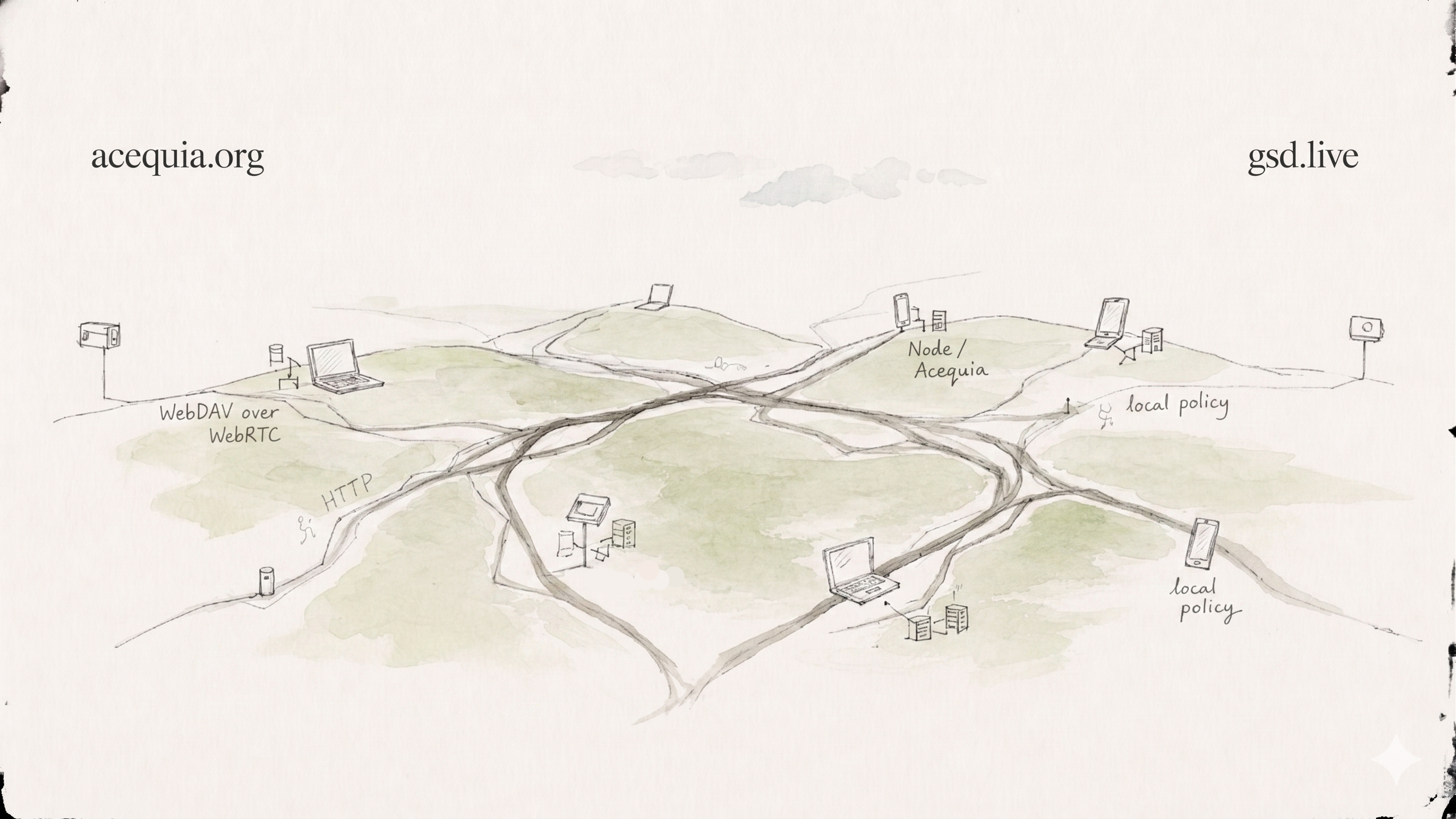
Figure 3: The stigmergic web as a multi-patch matrix: browsers, local services, and tunnels form many small patches and writable corridors where traces circulate and thicken into desire lines, rather than a single central cloud.
Returning to the contrast established in Figure 1, the stigmergic-web diagram is not yet the built ubiquitous solution, but a counter-image or conceptual direction for future intervention. It gestures toward an architecture where traces of cognition remain situated in the environment, rather than siphoned into a centralized enclosure.